Counter Intelligence: The Record Shop Trail of a 6 Music Spin
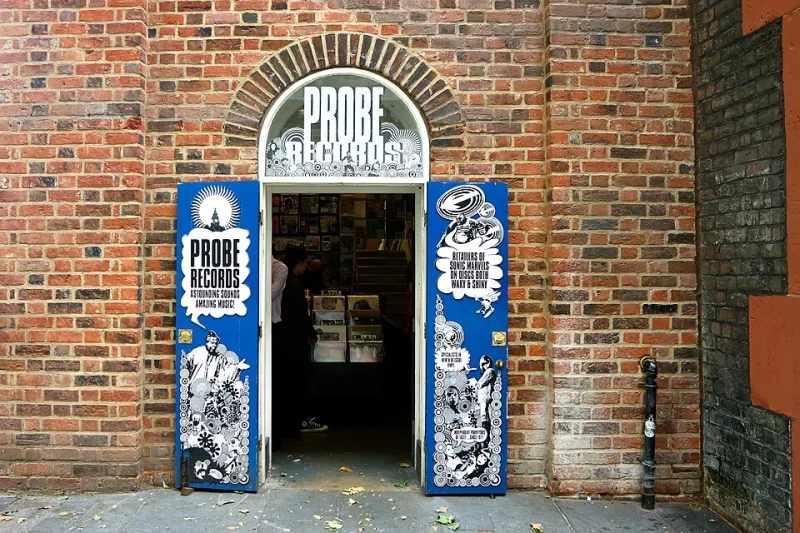
Photo: Matt Harrop , CC BY-SA 2.0, via Wikimedia Commons
Saturday morning, a record shop off Leeds' Kirkgate. Someone leans over the counter and says, apologetically, “It was on 6 Music on Thursday. Mid-morning. Sounded a bit like Talk Talk meets someone's nan's washing machine.” The person behind till doesn't blink. They pull up the tracklist, narrow it down, and within a minute there's a name, a label, and a question: “I can order it in for Tuesday. Want me to?”
That is the whole chain in miniature. A spin becomes a search. A search becomes a special order. A special order becomes a sale, a conversation, and—if we're lucky—a room full of people listening to something they'd never have found on their own. Record shops are the station's most tangible shop window. Not because they sell records, but because they show the rest of us what a public service music station actually does when it's working.
The ten-metre dash from radio to rack
There's a version of this that happens in every city. In Bristol, it's a shop on Gloucester Road where the staff keep a scrawled list of “6 Music mysteries” by the till—tracks customers have heard but can't name. In Sheffield, it's a Saturday queue that forms because someone played a reissue on the evening show and the shop had two copies. In Norwich, it's an owner who now checks the station's playlist before placing weekly orders, not because they're told to, but because it keeps the shelves alive.
The path is rarely glamorous. A listener hears a track. Shazam fails. They try to sing it to a shop assistant, who nods politely and then finds it on the station's tracklist. Sometimes the customer buys it there and then. Sometimes they special order it. Sometimes the shop sells out of the album and has to reorder. Either way, a play has become a purchase order. That's not a small thing. In an industry that often treats radio airplay and high-street retail as separate worlds, the till receipt proves they're the same ecosystem.
Why the counter is the campaign's best evidence
Here's the thing about streaming: it leaves no trace you can hold. A play is a data point. A record shop sale is a story. The assistant remembers the customer. The customer remembers the shop. The shop remembers the week 6 Music sent six people in asking for the same record. That's the kind of evidence that gets lost in a spreadsheet but matters when you're making the case for a station that isn't just a playlist with a licence fee.
We've spent months asking listeners to write to MPs, pin the dial on maps, and make a proper din. All of that matters. But record shops offer something different: they can show, physically, that 6 Music's influence isn't abstract. It's a shelf that had to be refilled. It's a special order that kept a small label afloat. It's a Friday-night listening post where people stand around a turntable because a presenter said, “Try this.”
That's why we're asking independent record shops to do two simple things. First, display a stack of Save 6 Music postcards by the till—nothing loud, nothing corporate, just a clear line to the campaign for anyone who asks what the station means. Second, share their own airplay receipts. Not a formal audit, just a note: “This week, three customers special-ordered records after hearing them on 6 Music.” A photo of the order book with the names blanked out. A tally on the back of a receipt. A sentence in a newsletter. Small, honest evidence from the shop floor.
The Friday-night listening post
Some shops already do this without calling it anything. They leave the station on in the background. They host a listening session on a Friday. They put a note in the window: “We're playing what they played.” It turns a shop into a room, and a room into a small, temporary community. You don't need a stage or a licence for that. You just need a decent set of speakers and a willingness to let the radio choose the next track.
In Glasgow, one shop has started a “6 Music shelf” each week—records that got a spin in the previous seven days, with a handwritten card explaining the connection. It's not a gimmick. It's a map of the station's taste, made physical. In Cardiff, an owner told us they've had people come in specifically because they heard the shop mentioned on a listeners' segment and wanted to see what the fuss was about. That's the shop window working both ways: the station sends people to the shop, and the shop sends a message back about why the station matters.
What we're asking
If you run an independent record shop, this is an open invitation. Stick a few postcards on the counter. Keep a sheet of paper for airplay receipts—date, record, how many enquiries, how many orders. Take a photo. Tell us about it. You don't have to be a campaigner. You just have to be a witness.
And if you're a listener, make the loop complete. Next time a 6 Music play sends you hunting, go into your local shop and ask. Don't just stream it. Order it. Talk to the person behind the counter. Tell them where you heard it. That conversation is the campaign in its most ordinary, most powerful form.
The order book doesn't lie. Neither does a sold-out shelf. Neither does a Friday-night room full of people who came for one record and stayed for three. 6 Music is worth defending because it does this—quietly, daily, across the UK. The shops are where you can see it happening. Let's make sure the people making the decisions can see it too.